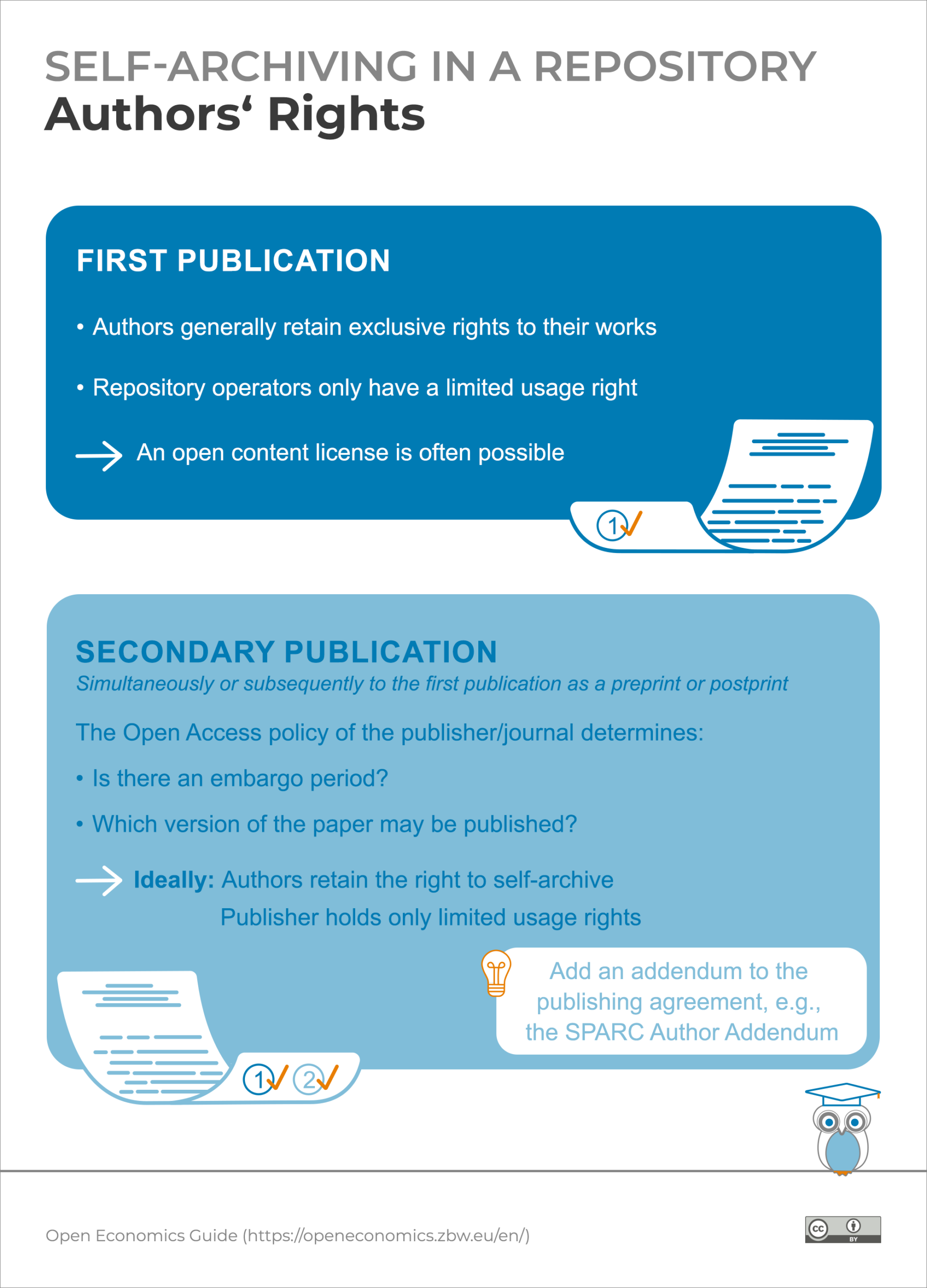
Self-Archiving: First and Secondary Publications
There are two basic ways to self-archive: (first) publication of previously unpublished works, and (secondary) publication of works that have already appeared elsewhere as journal articles, in a repository.
First publication in a repository
Unpublished works (primary publications) can be published in a repository. One advantage of repositories is that the content is permanently stored and widely accessible – which is not the case for academic social networks such as ResearchGate or Academia, nor for your own personal website. To ensure your research gets the widest possible dissemination and remains accessible both today and in the future, works should be made available at locations with carefully thought-out storage and reuse strategies. Copyright, archiving, machine readability and similar considerations are complex topics that repositories and other third-party sites are usually better equipped to handle than a personal website – which in turn increases the use of your article.
Repositories accept more than just articles – also dissertations, book chapters, posters, datasets, reports, lectures and conference papers. Authors are thereby able to retain the exclusive rights to their works and transfer only a simple usage right to the operator of the repository for making the document available on the internet. Alternatively, you can often also publish your works under an open content licence: this lets you determine under which conditions a document published in Open Access can be used by third parties, makes legal enforcement easier in the event of misuse, and gives users explicit information about how they may use the document.
Naturally, you can also use the option of first publication in Open Access for entire books.
Secondary publication in a repository
The secondary publication can take place simultaneously or subsequently to the first publication (for example as a preprint or postprint to a scientific article, but also as a monograph, research report, or conference paper). It is often only available after an embargo period, depending on the Open Access policy of the publisher or the journal.
Regarding the conditions for self-archiving, two points are decisive:
- the version of the paper that is permitted to be published, and
- the time when a publication is permitted.
Most publishers allow works to be made available in parallel in institutional or subject-specific repositories – often either the final author's version after peer review (accepted manuscript), or the final version published by the publisher.
Securing your right to self-archive
As far as possible, publishing agreements should be designed so that authors have the right to self-archive. Authors should therefore not transfer any exclusive usage rights to the publisher, and ideally grant the publisher only simple usage rights for the intended types of use.
If this is not possible in an often-standardized publishing agreement, see Safeguarding Your Rights: Before and After Signing the Contract for how to negotiate an author addendum or what rights you retain by law even after signing.
Self-archiving book publications
Some publishers now also make self-archiving of individual book chapters or complete books easier. Issues that authors can negotiate for book publications are similar to those for other kinds of publications:
- the openness of the publication,
- the costs involved, and
- the possibility of secondary publication in a repository.
You may sometimes be able to obtain publication under a free licence, or expand self-archiving possibilities, if you make an additional payment.