Safeguarding Your Rights: Before and After Signing the Contract
As the author, you possess all rights to your scientific text until you sign a publication contract, with which you relinquish some of these rights to the publisher. How much you retain can be shaped actively before signing, and at least checked after signing.
Before signing: negotiate an author addendum
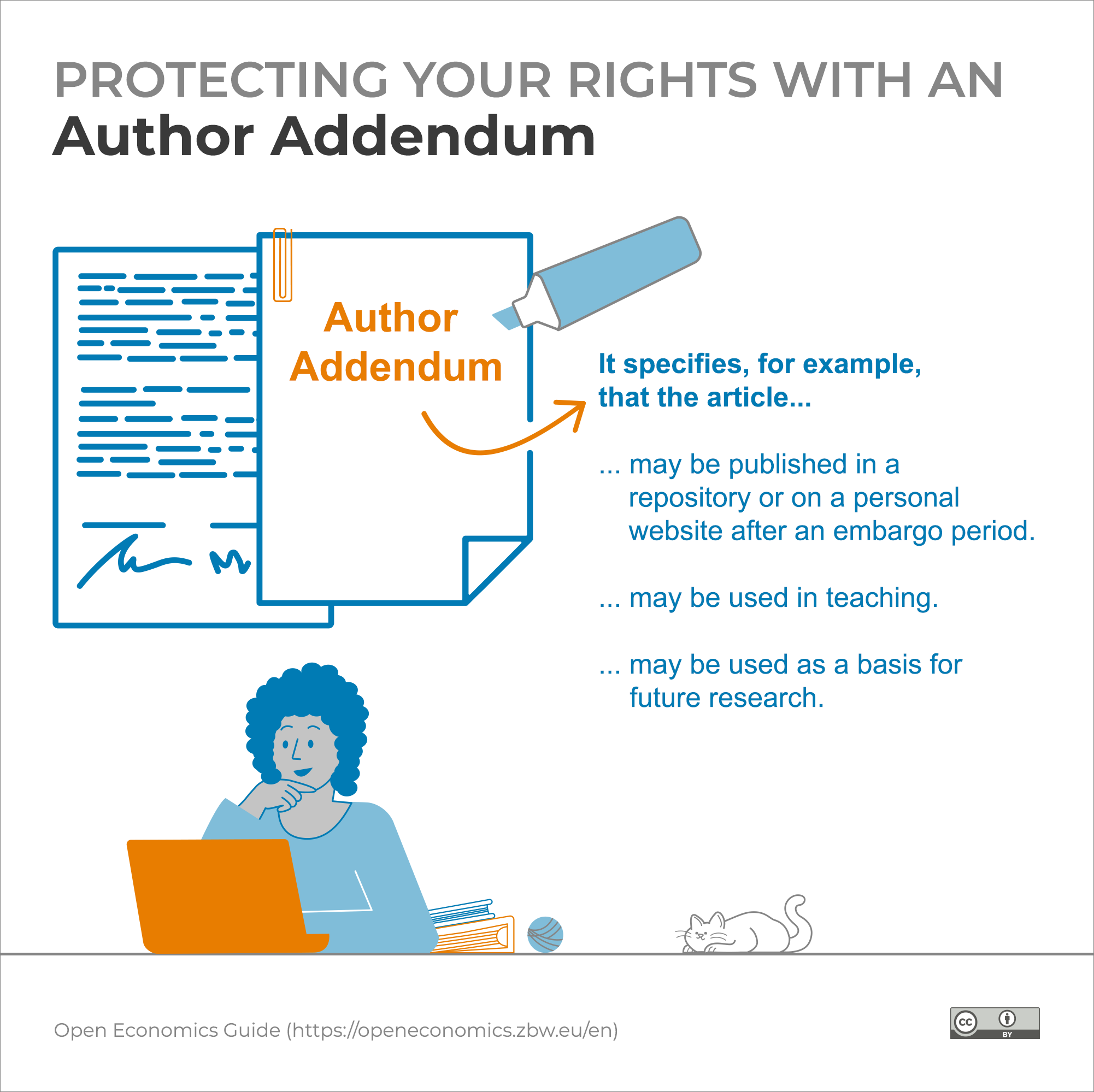
If you do not want to or cannot publish in an Open Access journal for any reason, agree an author addendum with the publisher – an author's addition to the standard contract that defines or changes the contractual conditions.
This enables you to protect important rights: for example, that you may publish your own articles and works on your personal website or in a digital repository, use them for teaching, or use them as the basis for future research. This makes it possible to use the green route of Open Access in the context of secondary publication, so you can at least make your publication freely available after an embargo period through self-archiving.
In Germany, there are also increasingly framework contracts for subscription journals that allow immediate publication in Open Access – for example the DEAL contracts with Elsevier, Springer Nature and Wiley (current terms 2024–2028).
Get in touch with the Open Access officers of your institution if you need help: they are experienced in applying author addenda that enable you to retain some or all of your rights.
After signing: what is already permitted?
Couldn't agree an addendum, or already signed? You typically still retain certain rights. Your publication contract may contain guidelines from the publisher on self-archiving, listing which version (preprint, postprint or final/published) you are allowed to share and which restrictions apply, such as embargo periods.
If your contract contains no such explanation, look for your publisher's self-archiving guidelines, or search for your journal in the Open policy finder for an overview of the relevant conditions. See also our post on Legal Issues for Open Science.
In Germany, authors have a statutory secondary publication right (Zweitveröffentlichungsrecht, § 38(4) UrhG). It applies even if you have granted the publisher exclusive rights. If a scholarly contribution came out of research that was at least half publicly funded, and it appeared in a collection published at least twice a year (such as a journal), you may make the accepted manuscript version publicly accessible 12 months after first publication. The use must be non-commercial, and you must cite the original source. This right cannot be waived by contract.