The Different Types of Open Access
The most common forms of Open Access that you may encounter are:
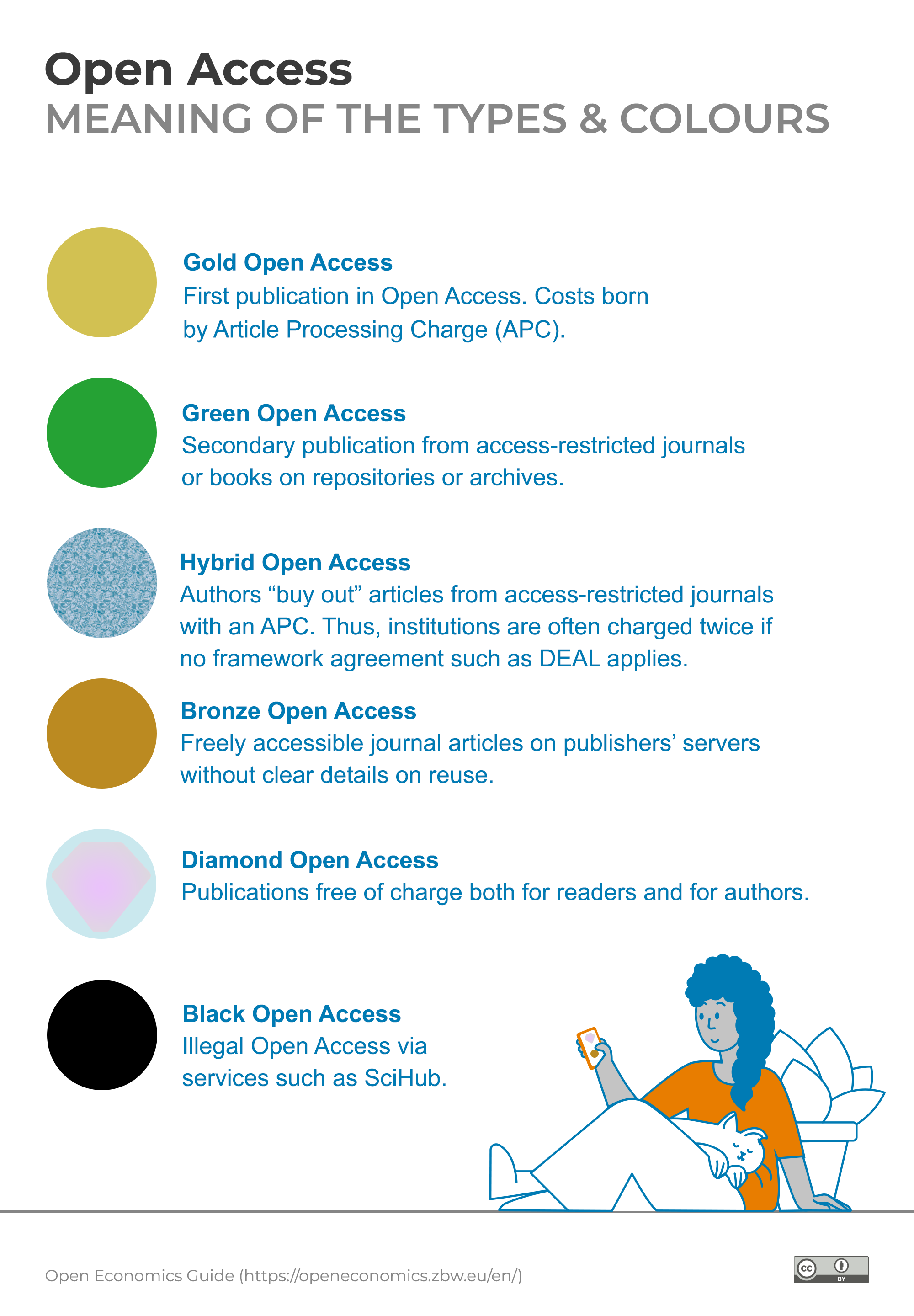
- Gold route (Gold Open Access): First publication in Open Access, for example as an article in an Open Access journal, an Open Access monograph, a contribution to an edited volume, or a conference paper published in Open Access. Publication costs are not borne by readers (in academic contexts, usually represented by institutional libraries), but by the producing party, such as authors, publishing institutions, publishers, or research funders.
- Green route (Green Open Access): Secondary publication of works originally published in access-restricted journals or books via institutional or subject-specific archives/repositories. This also includes making publications available on authors’ websites. Secondary publication may take place simultaneously with or after the initial publication, for example as a preprint or postprint of journal articles, as well as monographs, research reports, or conference proceedings. Under the green route, publications are often made freely available only after an embargo period, depending on the Open Access policies of individual publishers and journals.
- Hybrid Open Access: In this model, a journal remains access-restricted and is typically offered on a subscription basis. Authors may, however, make individual articles openly accessible by paying an article processing charge (APC). These fees are usually significantly higher than those charged by fully Open Access journals. Hybrid publishing often results in institutions being charged twice: once for journal access or subscription, and again for Open Access publication. For this reason, the model is controversial. Authors should therefore consider carefully whether paying these additional costs is advisable, particularly since articles can also be made openly accessible via repositories. Framework agreements, such as the DEAL agreements between academic institutions and major publishers, should be considered separately. Under these agreements, individual authors do not pay APCs themselves. Their aim is to transform the scholarly publishing system by converting subscription-based journals into Open Access journals. As long as this transformation remains incomplete, publishing in hybrid journals may represent a pragmatic compromise for authors.
- Bronze Open Access: Journal articles that are freely accessible on publishers’ platforms but lack clear information on reuse rights. This category mainly includes freely accessible content from subscription-based journals.
- Black Open Access: Illegal forms of Open Access provided through services such as Sci-Hub
- Diamond Open Access: Publications that are free of charge for both readers and authors. This category primarily includes Gold Open Access journals that do not charge article processing fees. Diamond Open Access is particularly widespread in the humanities and social sciences.