The Significance and Components of README Files
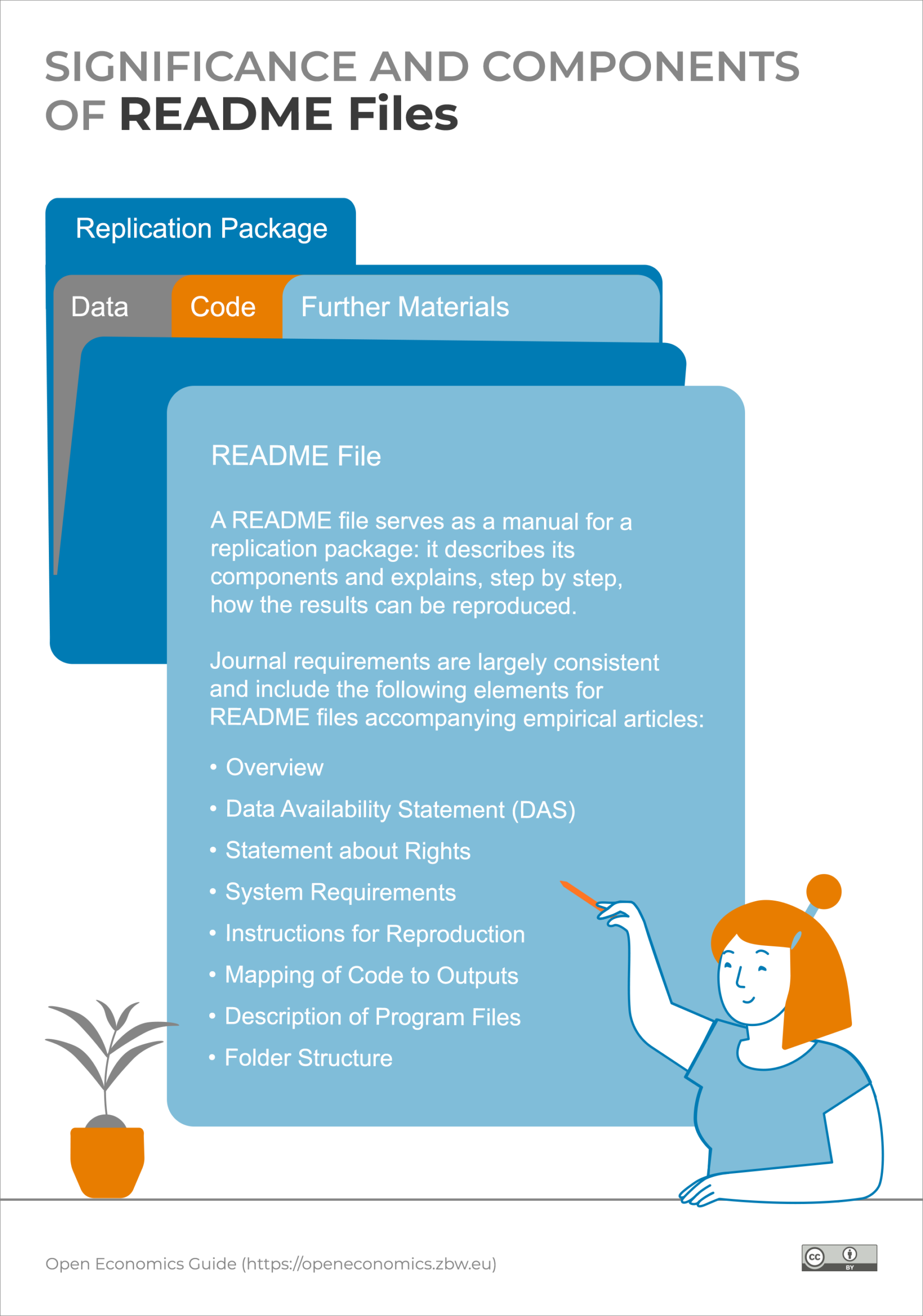
A README file is a text document describing a replication package. It explains the collection of data, code, and further materials accompanying an (empirical) research article, and sets out step by step how the results can be reproduced. In economics and business studies, a well-written README file is the most important component of a replication package. Without it, even fully shared data and code lose much of their value, as key information needed for interpretation, validation, and reuse is missing.
README files are primarily relevant for empirical articles, but can also be useful in other contexts: for example, when theoretical models are solved numerically or simulations are carried out and the associated code needs to be documented.
Many leading economics journals, including journals of the American Economic Association (AEA) and the Review of Economic Studies require a README file as a mandatory component of a replication package. Journal requirements are largely consistent and include the following elements for README files accompanying empirical articles:
- Overview
- Data Availability Statement (DAS)
- Statement about Rights
- System Requirements
- Instructions for Reproduction
- Mapping of Code to Outputs
- Description of Program Files
- Folder Structure
Several tools and templates are available to support the creation of README files. The most widely used in economics is the Social Science Data Editors Template README, formally endorsed by the data editors of the AEA, the Review of Economic Studies, the Economic Journal, and the Canadian Journal of Economics. Further options include the Worldbank README Template and templatereadme.org.