Benefits of Pre-Registration
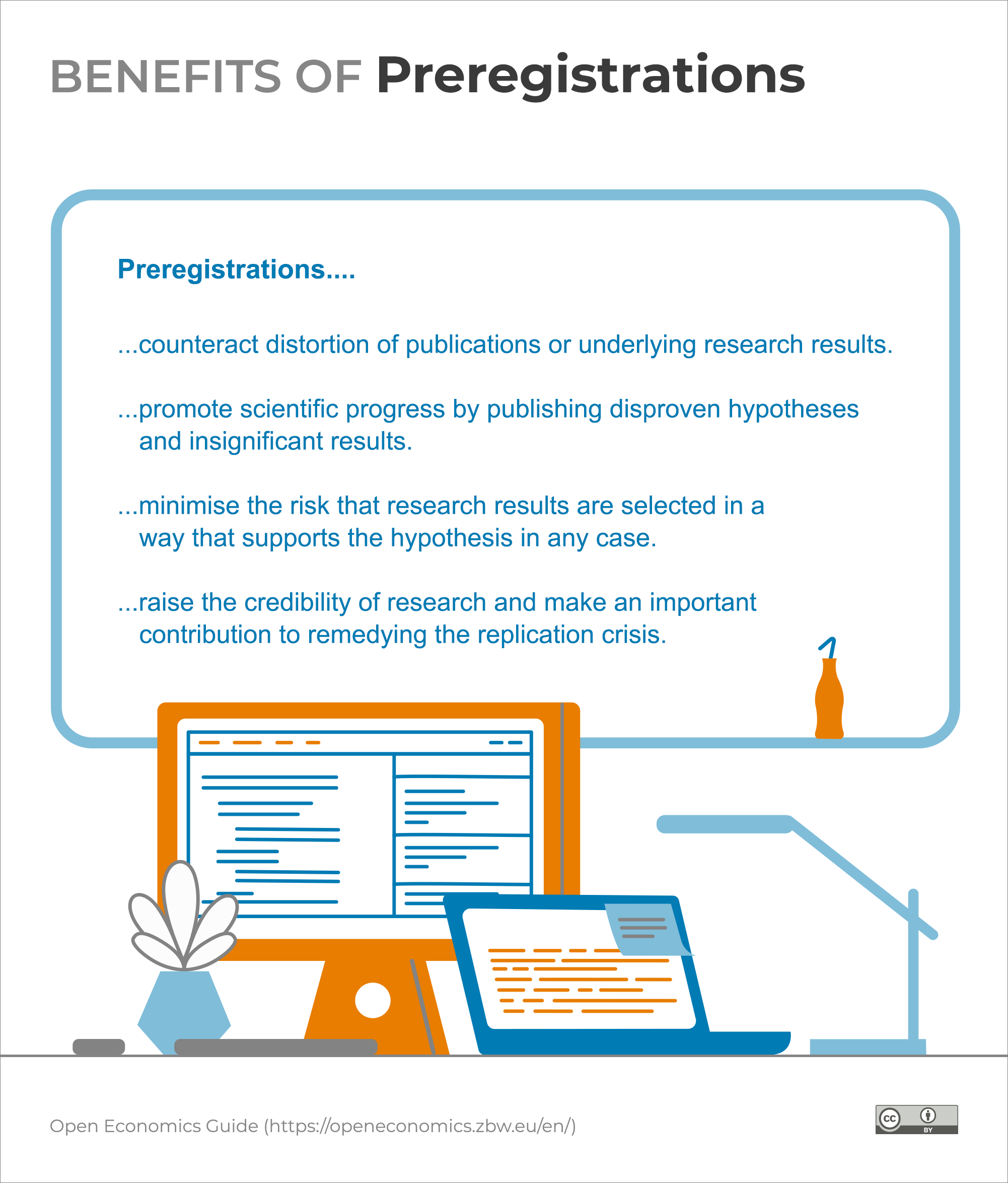
A preregistration is a timestamped document in which researchers describe their research plans before conducting their study. It can be made public immediately after registration or kept private under an embargo until a specified date, for example, upon publication of the study. It fixes the initial research questions/hypotheses, research design, and analysis strategies, making them transparent for others. Pre-registration is intended to prevent the distortion of research results. It is of great benefit to scientific progress if disproven hypotheses and insignificant results are also published.
If researchers announce their hypotheses and research design in advance, this minimises the risk that research results are interpreted or selected in a way that supports the hypothesis, no matter what the result of the study is. Thus, the public pre-registration of the experiment planning and the analysis plan before data collection is an effective way to minimise distortions and raise credibility. Pre-registration thereby makes an important contribution to remedying the replication crisis. However, pre-registration may not always be appropriate for all kinds of research or publications. A few specialist journals already demand registered reports. Tßhis could become common practice for research publishing.
The additional effort for pre-registration is often smaller than expected. As the pre-registration documentation is written similar in form to a methodology paragraph, much of the work overlaps with standard research practice. In practice, templates with pre-defined questions and requests help to guide researchers through the process and ensure that all critical questions are addressed.