Tools for Open Science
A variety of tools can support you in practicing Open Science. In our tool overview, we have compiled a selection for you and classified each tool according to the different phases of the scientific workflow.
Recognising suitable Open Science tools
When selecting tools for Open Science, it's a good idea to check a few criteria — including the extent to which the tool itself meets Open Science criteria. Fundamentally, it is also worth checking which tools are already established within your own community.
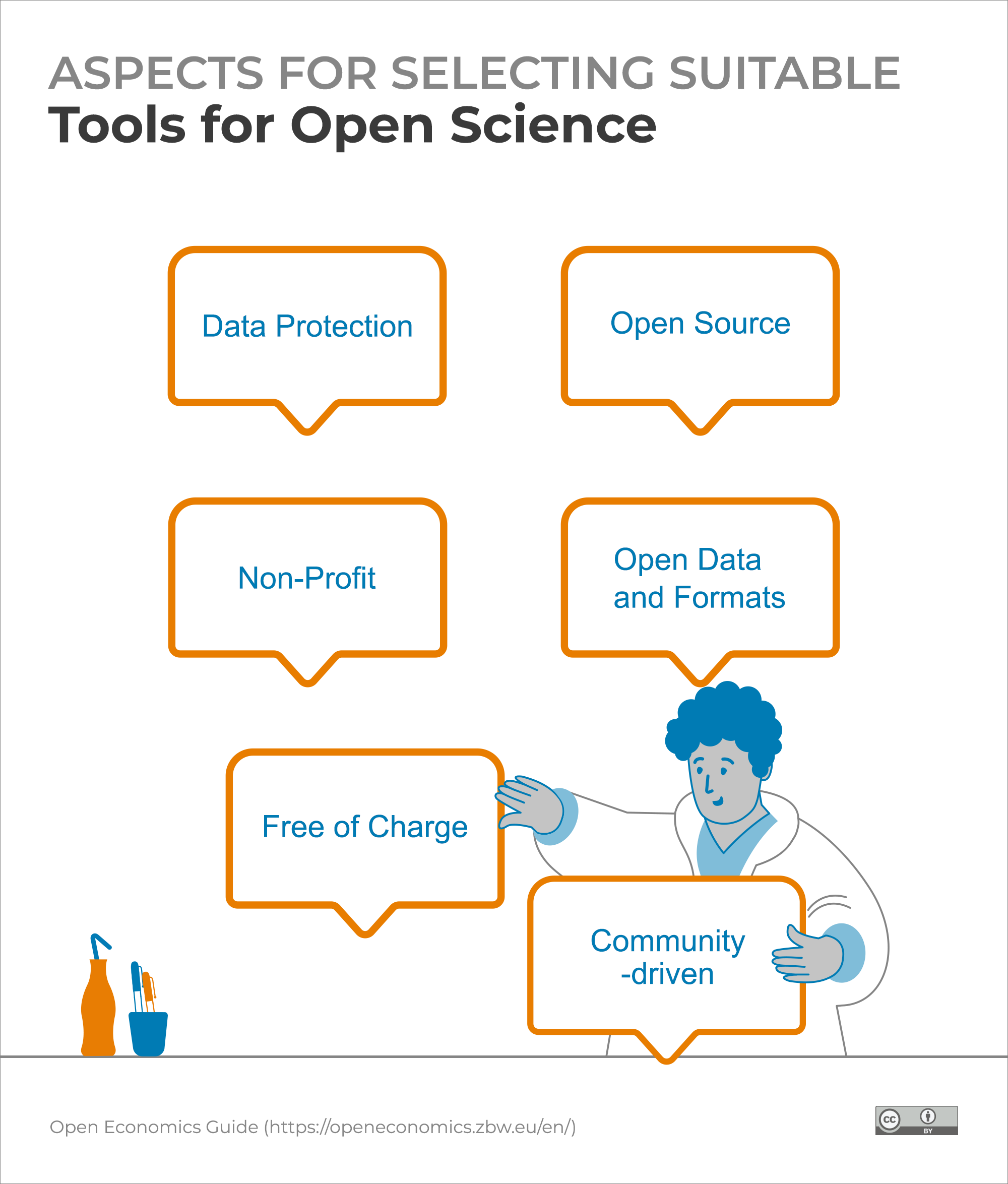
You might find the following aspects helpful when selecting suitable tools:
- Costs: Is the use of the tool free of charge? Commercial providers in particular often offer chargeable packages with expanded functions alongside free use. Non-profit institutions generally offer their tools free of charge to end users; operating costs are instead financed through an institute's budget or membership models, for example.
- Open Source: Is the tool itself open source? An open-source tool offers more opportunities for further development and is often an important enabler for the dissemination and acceptance of a tool within a community. Examples include the programming languages R and Jupyter.
- Operator: Who operates the tool? This could be a commercial provider or a non-profit institution, including scientific infrastructure or research institutions. This can also help you assess how sustainable a tool is likely to be.
- Community-driven: Is the tool developed by the scientific community? This has the advantage that the tool's development is guided by the community's needs, giving it more influence over future development. Crossref and DOAJ are examples.
- Further openness criteria: Is the data openly licensed? Are standardised formats and interfaces used? Alongside open source, these are further aspects of an "open" tool. For example, all data on Wikidata is CC0-licensed and machine-readable via an API, making it widely reusable. Content on DOAJ is available under a CC BY-SA licence.
- Data protection: Are you processing personal data, and does the tool meet data protection requirements (is it GDPR-compliant)? If in doubt, contact your institution's data protection officer.
To give you a first impression, you can find a small selection of Open Science tools here:
Open Science tools of the ZBW:
As a public institution, the ZBW – Leibniz Information Centre for Economics offers several non-commercial Open Science tools directly for the field of economics. These include:
Comprehensive Open Science tools
The Open Science tools that cover the majority of the scientific workflow and/or various Open Science fields include:
Tool collections with Open Science tools. (You will find certain tools at the corresponding Open Science topics.):
- Toolbox – Resources for Researchers of the Open Science Center of the LMU Munich with tools for planning research, for implementation, for data analysis and the publication of data, materials and papers.
- Infra Finder by Invest in Open Infrastructure as a catalogue and comparison platform for open science infrastructures, providing information on openness, governance, and areas of use across the research workflow; primarily aimed at libraries, infrastructure providers, and researchers in coordinating roles.