Individual Benefits of Open Science
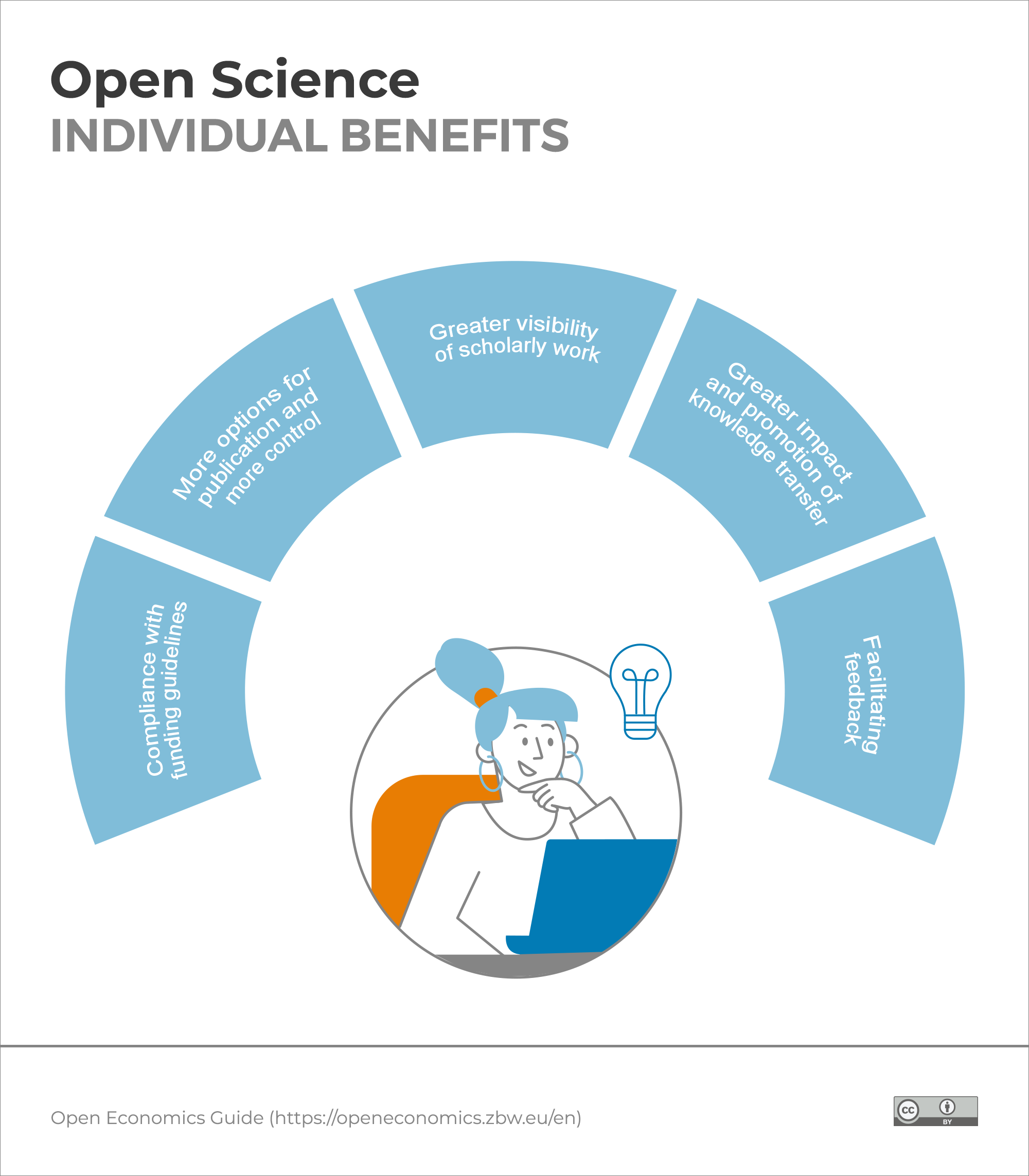
Benefits that Open Science can bring to individual researchers include:
- Greater visibility and reach of scholarly work: Open Science can lead to higher citation rates as well as to greater visibility beyond one's own research community. Studies show that Open Access publications are more widely used than literature with restricted access, and that open data also finds application outside academia. Researchers who additionally publish other research outputs – such as code – in a repository can also receive credit for these. Gathering all outputs under a persistent identifier such as an ORCID iD further increases the discoverability of one's work. Our blog post explains the six concrete steps through which Open Science practices can be used to systematically increase the visibility of your publications.
- Greater impact and promotion of knowledge transfer: Open Access to research results creates opportunities for findings to be applied in practice – in other disciplines, but also beyond academia, for instance in policy, business, or civil society. For researchers, this means broader recognition of their work outside their immediate field and the possibility of contributing visibly to real-world challenges. This can build reputation and networks beyond academia, for example through media coverage, collaboration requests from practitioners, or involvement in policy advisory processes. How this kind of impact can be measured is discussed in the entry on Open Science and Alternative Metrics in Research Evaluation.
- More options for publication and more control: Open Science provides new opportunities and more control over how and where one's work is published – for instance through preprints, self-archiving or the choice of journals with open licences. An overview of suitable publication routes is provided in the Open Access section.
- Compliance with funding guidelines: Research organisations are increasingly requiring the use of Open Science practices. What specific requirements individual funders set regarding Open Data and how research funding institutions approach Open Science more broadly, is outlined in the linked entries.
- Facilitating feedback: Open Science can make it easier to receive constructive feedback on research work and thus improve its quality – for example through early publication as a preprint or through Open Peer Review.
The goals of Open Science and the benefits it can bring to the science system and society as a whole are summarized in the overview "Goals of Open Science".