Five Steps for Getting Started with Open Science
Start with small steps. Open Science does not have to require a great deal of effort. If many researchers take small steps, this benefits researchers themselves as well as science and society. Many practices and solutions can be implemented with minimal effort, allowing you to achieve a great deal with relatively little input.
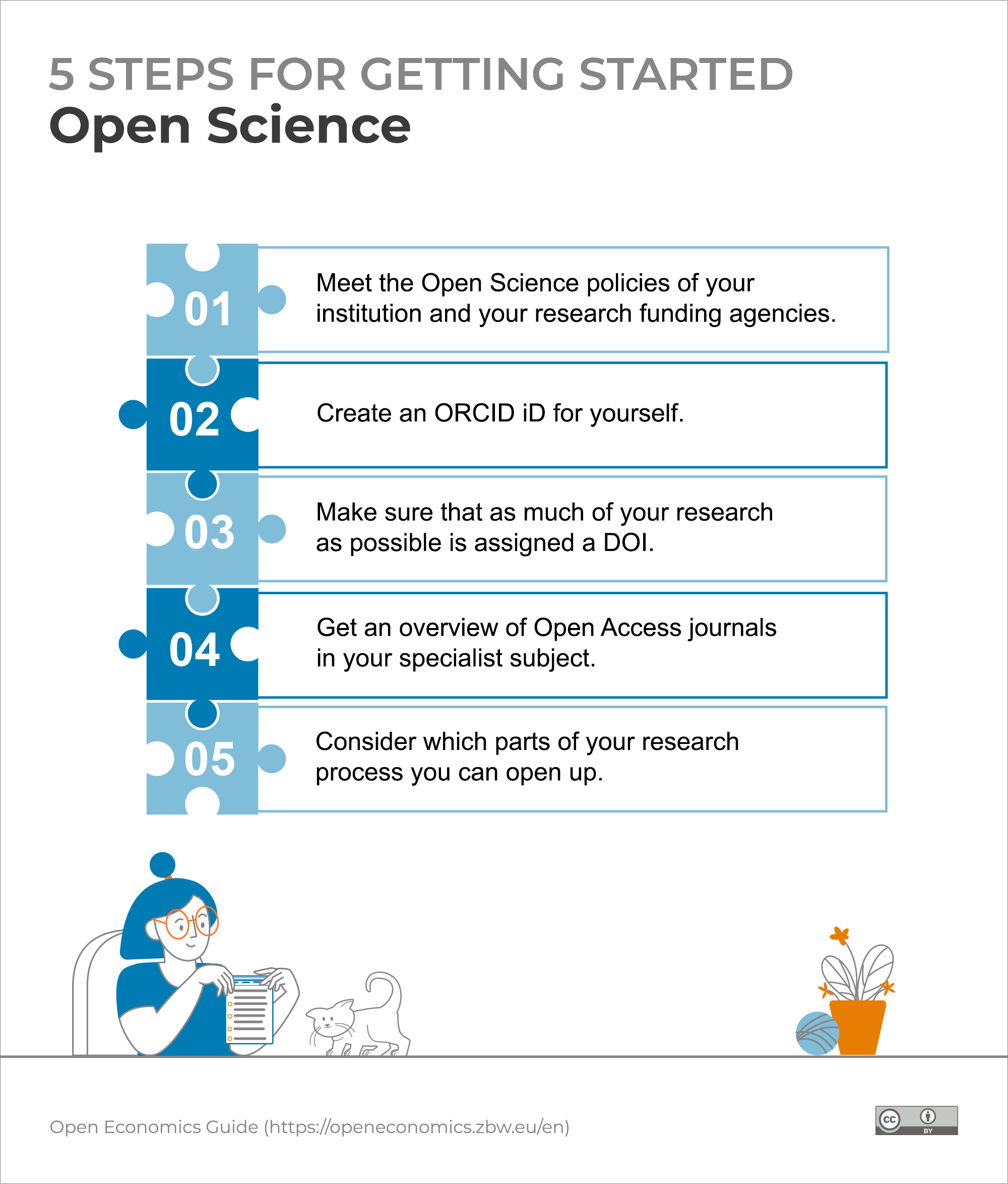
Five Steps for getting started in Open Science:
- Comply with the Open Science policies of your institution and your research funding agencies. These may include policies for Open Access, Open Data, and for research data management.
- Create an ORCID iD for yourself. This will ensure that your research correctly attributed and easier to find, thereby supporting your visibility (see also the worksheet "Speed up your publishing process via ORCID ID" in the ZBW's Open Science Magazine).
- Make sure that as much of your research as possible is assigned a Digital Object Identifier (DOI), including your research data, for example. This will make them easier to find, cite, and re-use.
- Get an overview of Open Access journals in your specialist subject. The Directory of Open Access journals can be useful here. Publish in Open Access whenever possible.
- Consider which parts of your research process you can open up. Check out the six main areas of Open Science, start with the easiest part, and give it a try!
The individual sections on Open Science in the Open Economics Guide also provide ideas for getting started, such as implementing Open Access.
Do you want to take it a step further? You can find more recommended steps for integrating Open Science into your research activities on openscience.eu blog: Five ways to incorporate open science practices into your workflow .
The Open Science Researcher Checklist by the EU-funded project ORION also offers a starting point for Open Science.