Making Open Science irresistibly easy is the Wharton Credibility Lab’s mission. They established AsPredicted, a pre-registration platform, and ResearchBox, a platform for sharing data, code, and materials. In October, they added their newest platform AsCollected, which supports documenting results provenance. Read how the three platforms are integrated and designed to seamlessly support the research process.
The Penn Wharton Credibility Lab at the University of Pennsylvania mission is to make open research irresistibly easy to use by providing online platforms that make it simple for authors and for readers. In doing so, it has released its third online platform and relaunched the existing services in October 2025. The three platforms support various aspects important for Open Science, among them: Open Code, Open Data, fostering transparency and credibility, simplifying journal submissions and giving proper credit for research work. Learn more about the three platforms in the following short introductions.
AsPredicted
At AsPredicted you can pre-register studies and others can evaluate your planning. Read about the benefits of pre-registrations in this entry and how pre-registration work in this one. If you are interested in another researcher’s first-hand experiences with pre-registrations, this blog post might interest you.
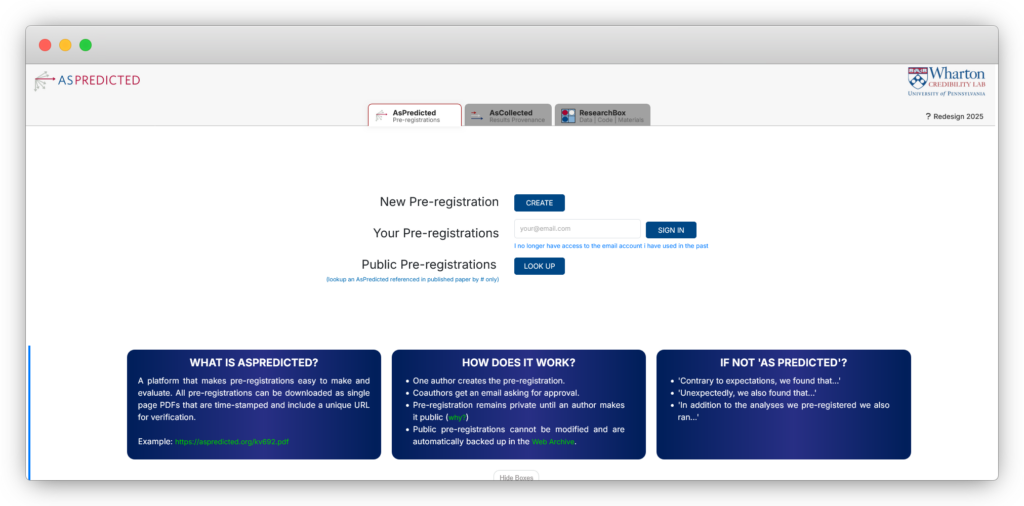
For pre-registering at AsPredicted, researchers have to answer simple questions about their research design and analyses. Then, AsPredicted generates a time-stamped pre-registration document (PDF) with a unique URL which can be shared and read by others. A Pre-registration is private first, unless an author makes it public. After publishing, pre-registrations can no longer be modified and are automatically backed up.
AsCollected
With AsCollected Wharton Credibility Lab has created the first platform designed for documenting "results provenance". Here, authors can indicate how, when, and where data were collected, and which authors cleaned and analysed the data.
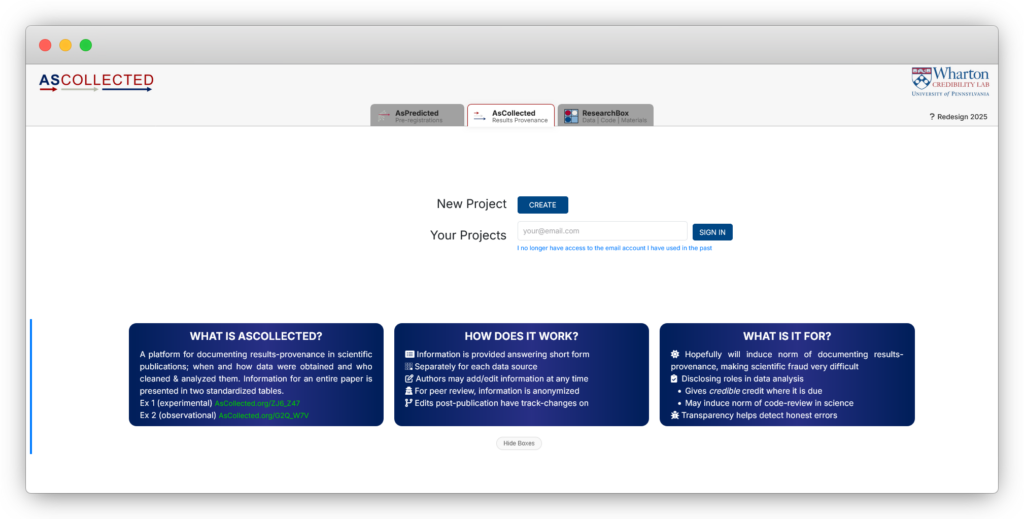
So, the platform increases transparency with regard to the origin of research results and the roles in research work, hampering scientific fraud and fostering giving credit where it is due. Researchers enter the information in a short form. A single AsCollected project serves to document the provenance of results for an entire published paper. Data for each source is stored separately and anonymised for peer review.
ResearchBox
If you want to easily share data, code, and materials, ResearchBox might suit you.
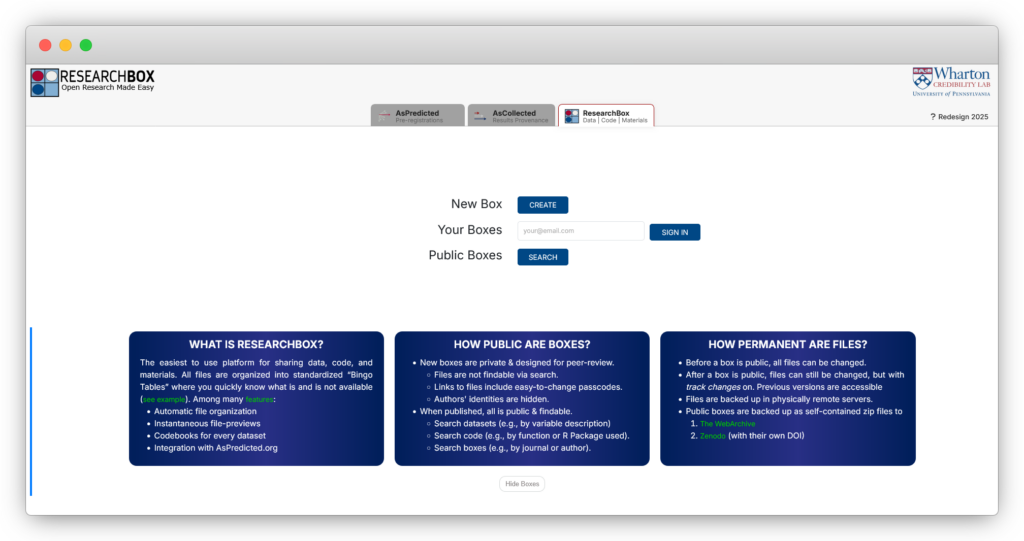
Storing everything you need in boxes which are organised as standardised “bingo tables” on the platform simplifies submitting to a journal. These tables also offer a quick overview of available information. The platform’s features include automatic file organisation and codebooks for every dataset. New boxes are private. When a box is published its content is public and findable. Modifications are possible, but all changes are being tracked and previous versions are accessible.
How and when the three support the research process
All three platforms are designed to be easy-to-use and are fully integrated, being accessible with a single login. You can seamlessly switch from one platform to the other.
The Wharton Credibility Lab suggests this proceeding for authors using the platforms ascollected.org/redesign@ : After designing the first study in your project, pre-register it with AsPredicted. After analysing results, if the study is plausible and you aim to publish it later, create an AsCollected project and enter the results-provenance there. In case of designing followup studies, repeat the previous steps. Then, when everything is done and you are ready to submit your paper to a journal, create a ResearchBox.
Still not enough? If you want more Open Science tools, have a look at the Open Economics Guide’s tool catalogue containing loads of more tools.