Open Science encompasses a wide range of approaches, methods and practices, which can quickly become overwhelming, particularly for those new to the field. The publication ‘Expedition Open Science Land: A Travel Guide for Business Research’ addresses this challenge. Using the metaphor of a journey, it encourages researchers in business studies to take their first steps towards Open Science.
The publication ‘Expedition Open Science Land: A Travel Guide for Business Research’ was published in January. The idea for the travel guide came from the authors Marko Sarstedt, Doreen Siegfried (ZBW), Meikel Neumann, Susanne J. Adler, Oliver Genschow and Monika Imschloss during a panel discussion on Open Science in business studies at the VHB conference in 2024. The interdisciplinary group of business studies and psychology researchers and science communicators is united by their conviction that scientific research should be transparent, replicable and open.

Open Science is presented in an accessible and clear way. Key aspects are deliberately abstracted and sometimes exaggerated, so that the publication offers guidance while it can be enjoyed with a wink. Designed for beginners, it also offers experienced researchers points of reference for reflection and for further developing their practice.
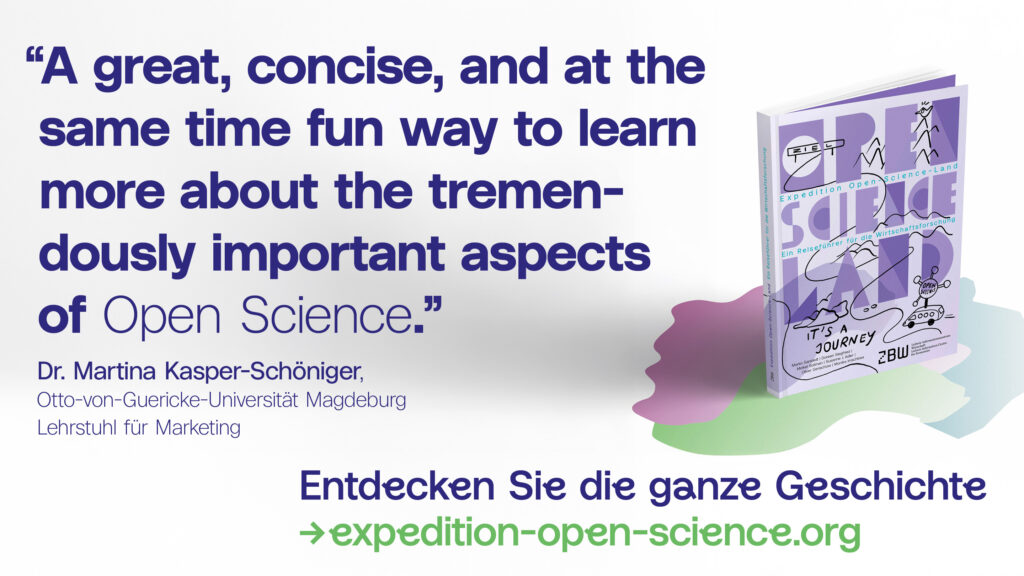
First, ‘Open Science Land’ is presented as a separate ‘natural and cultural space’. Readers learn about its history and ‘currency’ – that is, new evaluation standards for research that no longer focus solely on citation counts and prestigious publications, but also on transparency and reproducibility. The ‘climate’ is described as predominantly friendly, with the caveat that adaptability is necessary, as openness can also provoke critical feedback.
Subsequently, the three ‘central regions’ of the research process are described. The chapter on planning deals for example with pre-registration and collaborative approaches such as Big Team Science. The section on documentation offers practical tips for sharing and reusing Open Data and Open Code. The chapter on dissemination focuses on science communication. Among other things, it highlights the advantages of Open Peer Review and various ways of actively sharing research results in an open and accessible manner – for example, via preprints or social media.
Finally, the guide addresses typical misconceptions and myths surrounding Open Science before the expedition ends in an ‘oasis of reflection’. Here, both the significance of Open Science for business studies and possible future developments are discussed.
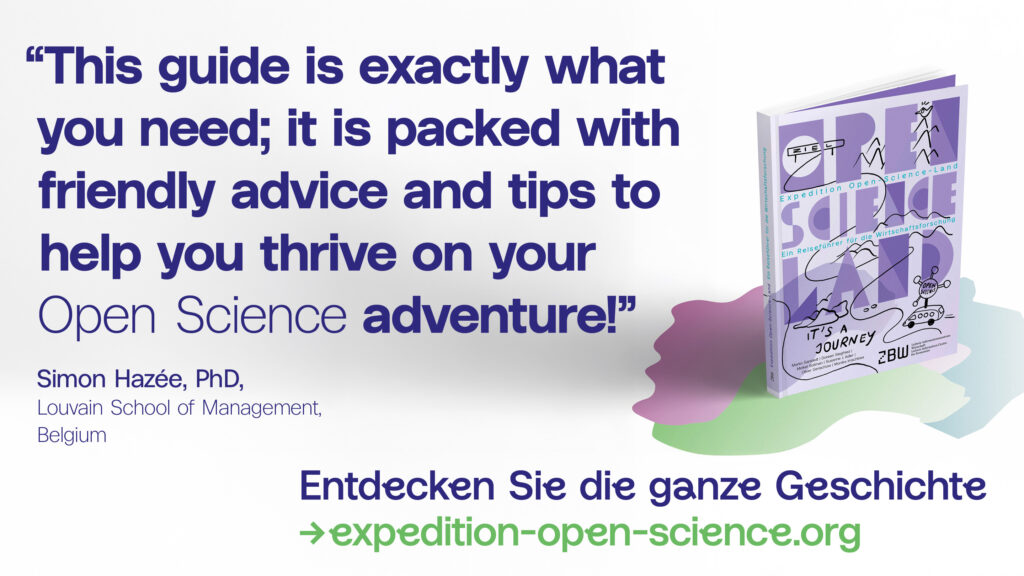
The complete guide in German and English language can be found here. In addition, an exhibition has been taking place at the ZBW in Kiel since the beginning of February. Designed as a tour of ‘Open Science Land’, it invites visitors to explore Open Science beyond the text.
Tip: Want to get started with Open Science right away? Here you will find five steps for a quick start in Open Science.